Flooded basement help
Basement Flooding Cleanup in Manchester, NH
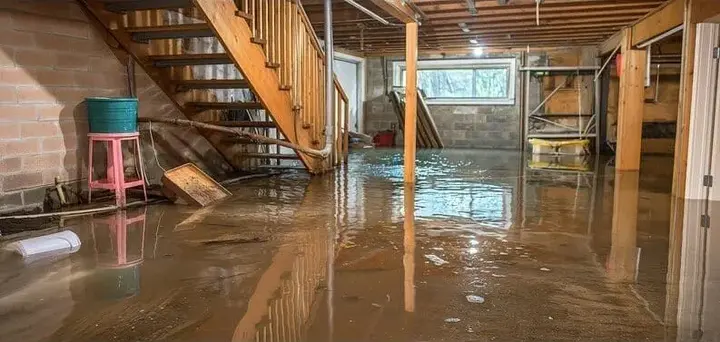
Water on the basement floor spreads into stored boxes, finished walls and the furnace area fast. The restoration team pumps it out, sorts it by category and dries the space to a verified reading.
(888) 670-6527Pump out the Manchester basement now- 24/7 dispatch
- IICRC S500 drying standard
- Daily moisture readings
First steps
What to do first for a flooded basement in Manchester
- 01
Keep power off
Stay out if water is near the panel, outlets or furnace; shut power at a dry panel only.
- 02
Find the source
Check for a broken pipe, the water heater or a quiet sump pump.
- 03
Photograph the waterline
Capture how high the water rose on walls and stored items.
- 04
Lift and call
Move what you safely can upstairs, then call for pump-out.
The process
How a flooded basement is handled in Manchester, NH
- 1
Pump and extract
Submersible pumps and truck-mounted extraction clear the standing water.
- 2
Sort by category
The restoration team classifies the water and marks porous materials to keep or remove.
- 3
Open wet cavities
Flood cuts or small openings let air reach framing and insulation.
- 4
Dry and verify
Dehumidifiers and air movers run until daily readings reach the drying goal.
Typical cost
What does basement flooding cleanup cost in Manchester, NH?
In Manchester, NH, basement flooding cleanup typically runs $1,500 to $12,000 or more, depending on the depth of water, the category, whether the basement is finished and how fast pumping started.
Unfinished, clean water
$1,500 to $3,500
- Pump-out and extraction
- Dehumidification
- Moisture verification
Finished lower level
$3,500 to $8,000
- Carpet and pad removal
- Flood cuts on drywall
- Daily readings
Category 3 or deep water
$8,000 to $12,000+
- Containment and PPE
- Full porous removal
- Antimicrobial treatment
For a closer planning number, try the water damage cost calculator. The final figure comes from the walkthrough and the moisture map.
A Manchester basement can flood from almost anything: a burst pipe, a failed water heater, a sump pump that quit, groundwater in spring, or a floor drain that backs up in a storm. The first job is the same every time. The extraction crew pumps out the standing water, figures out which category it is, and only then decides what can be dried and what has to go.
What floods Manchester basements
- Supply lines, boilers and water heaters that fail in the basement itself
- Sump pumps that die or get overwhelmed during a thaw or a long rain
- Groundwater pushing through old fieldstone and brick walls in spring, covered on the foundation seepage page
- Floor-drain backups in the older parts of the city, where storm and sewer water share pipes
Finished basements versus old cellars
Finished lower levels in the South End and out toward Lake Massabesic have carpet, pad and drywall that hold water. Clean water caught early can often be dried in place; the drying team may cut the bottom of the drywall to open the cavity, a flood cut, when water has wicked up. Category 2 and 3 water means carpet, pad and the lower drywall come out.
Unfinished cellars under older homes and triple-deckers have concrete or dirt floors and stone or brick walls. There is less to remove, but those walls hold moisture and the space is often poorly ventilated. LGR dehumidifiers do most of the work, with air movers on the floor and wall base.
Keeping the damage from coming back
Once the basement is dry, it is worth looking at why it flooded. A battery backup on the sump pump, a backwater valve on the floor drain and gutters that carry water away from the foundation solve many repeat floods. FEMA flood maps show whether a property sits in a mapped flood zone, and the National Weather Service explains flood alerts.
Do not go down into a flooded basement if the water is near the electrical panel, the furnace or outlets. Keep the power off and let the extraction crew assess it.
Service area
Covering Manchester and the nearby Merrimack Valley towns
The Manchester restoration team covers every ward of the city, from the North End and the Millyard to the West Side, the South End and the Lake Massabesic side.
Coverage also reaches Bedford, Goffstown, Hooksett, Auburn, Londonderry, Litchfield and Merrimack, ZIP codes 03101, 03102, 03103, 03104, 03105 and nearby.
See every neighborhood and ZIP codeRelated
Related water damage services in Manchester
Questions
Basement Flooding Cleanup questions, answered for Manchester
Can a finished basement be saved?
Often, when the water is clean and extraction starts quickly. Carpet pad and the bottom of the drywall are the usual casualties. Category 3 water means porous materials come out.
Is basement flooding covered by insurance?
It depends on the cause. A burst pipe is usually treated differently from groundwater or a sewer backup, which may need a separate endorsement. Coverage depends on your policy, so it is worth checking with your own insurer.
How long does a flooded basement take to dry?
Three to five days is common for a contained loss. Deep water, stone walls and finished spaces take longer, and the drying team goes by daily readings.
Should I pump the water out myself?
A small amount of clean water, yes, if the power is off and it is safe. Deep water, sewage or water near the panel should be left to the crew.
What about my furnace and water heater?
Appliances that sat in water need to be checked by a qualified technician before they run again. The restoration team dries the space around them.
Why does my basement smell musty after it dried?
Usually because something porous stayed wet, such as pad, insulation or the base of a wall. A moisture map finds it so it can be dried or removed.
24/7 dispatch
Basement Flooding Cleanup in Manchester? Call now.
The restoration team extracts, dries to the IICRC S500 goal and documents the loss for the claim file, across the city and the nearby towns.