Emergency water removal
Water Extraction in Manchester, NH
Standing water keeps wicking into subfloor, plaster and framing until it leaves the building. The extraction crew pulls it out with truck-mounted units and builds the drying plan around a moisture map.
(888) 670-6527Start water removal in Manchester- 24/7 dispatch
- IICRC S500 drying standard
- Daily moisture readings
First steps
What to do first for water extraction in Manchester
- 01
Stop the source
Close the main shut-off or the fixture valve so no new water reaches the floor.
- 02
Stay out of deep water
Do not wade near outlets, cords or appliances; kill power only from a dry panel.
- 03
Photograph every room
Take pictures before anything is moved or thrown out, for the claim file.
- 04
Lift and call
Get rugs, boxes and cushions off the floor, then call for extraction.
The process
How water extraction is handled in Manchester, NH
- 1
Moisture map
Pinless meters and thermal imaging trace where the water went, room by room and floor by floor.
- 2
Truck-mounted extraction
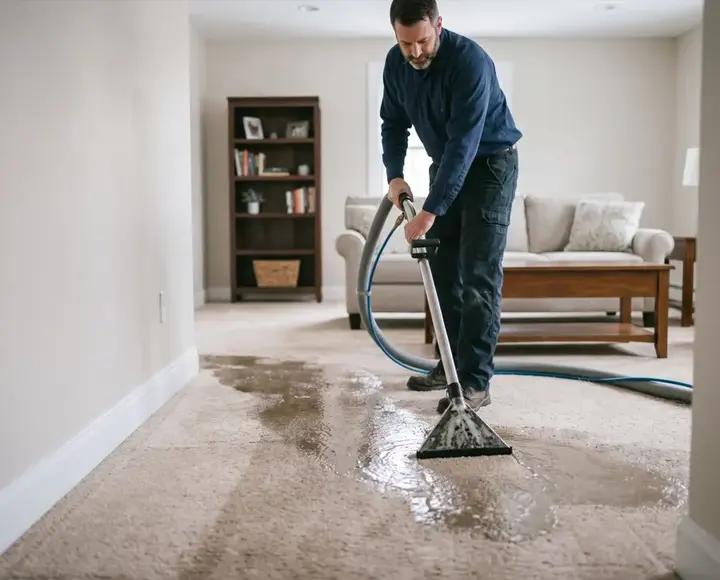
The extraction crew pulls standing water and wrings carpet, pad and hardwood surfaces.
- 3
Equipment set
Air movers and LGR dehumidifiers go in at the evaporation load of each room.
- 4
Daily readings
The drying team logs readings every day until materials hit the drying goal.
Typical cost
What does water extraction cost in Manchester, NH?
In Manchester, NH, water extraction typically runs $400 to $6,000 or more, depending on how much water there is, the water category, how many rooms or floors it reached and how quickly extraction started.
One room, clean water
$400 to $1,200
- Truck-mounted extraction
- Carpet and pad wrung out
- Moisture check
Several rooms or a basement
$1,200 to $3,500
- Pumping plus extraction
- Floor-by-floor moisture map
- Drying equipment set
Multi-floor or Category 3
$3,500 to $6,000+
- Protective gear and containment
- Porous materials removed
- Antimicrobial and drying
For a closer planning number, try the water damage cost calculator. The final figure comes from the walkthrough and the moisture map.
Every Manchester water loss starts the same way: the water has to leave the building before drying can work. Air movers and dehumidifiers remove moisture that has already soaked in; they do almost nothing to a puddle. So the extraction crew pulls standing and trapped water first, and every hour it sits is more water wicking into subfloor, baseboard and the bottom of the plaster.
Why extraction comes before drying in Manchester
A gallon of water left on a floor becomes a gallon of water inside the floor. Pulling it out mechanically is far faster than evaporating it, which is why the restoration team treats extraction as the step that decides how long the whole job runs. Faster, deeper extraction usually means fewer days of equipment and fewer materials cut out.
- Truck-mounted units carry the water out of the house instead of moving it to the next room
- Weighted extraction tools press water out of carpet pad so the pad can sometimes be saved on a clean-water loss
- Hardwood gets surface extraction first, then drying mats that pull water up through the boards
- Submersible pumps handle deep water in a basement before the wands go in
What the extraction crew pulls, and from where
The tech who does the walkthrough maps moisture with pinless meters and thermal imaging before any equipment goes down, because water in Manchester houses rarely stays where it landed. It runs along joists, under trim and down through floor penetrations. The map shows where to extract hard and where to open a cavity.
Category matters too. Clean supply-line water can often be extracted and dried in place. Water that sat for a day or came from a washer drain is Category 2, and anything from a floor drain, the river or the sewer is Category 3, which turns extraction into a removal job handled under sewer backup cleanup protocols.
Extraction in older Manchester buildings
Much of the city's housing is older multi-family stock: triple-deckers on the West Side, tenement blocks near the Millyard, big old houses in the North End. In those buildings water travels down, so a leak on the third floor often means extraction on every level below it, including the ceiling cavity of the unit underneath. The restoration team checks each floor rather than assuming the water stopped where it started.
Basements with fieldstone or brick walls add another step: water that collects along the base of the wall gets pumped and extracted before the structural drying starts. The Ready.gov flood page covers basic safety around standing water, and the EPA explains why wet materials need to be dried inside 24 to 48 hours.
Standing water near outlets or appliances? Stay out of it, keep the power off at a dry panel, and let the extraction crew handle the water.
Service area
Covering Manchester and the nearby Merrimack Valley towns
The Manchester restoration team covers every ward of the city, from the North End and the Millyard to the West Side, the South End and the Lake Massabesic side.
Coverage also reaches Bedford, Goffstown, Hooksett, Auburn, Londonderry, Litchfield and Merrimack, ZIP codes 03101, 03102, 03103, 03104, 03105 and nearby.
See every neighborhood and ZIP codeRelated
Related water damage services in Manchester
Questions
Water Extraction questions, answered for Manchester
How much does water extraction help compared with just running fans?
A lot. Pulling water out mechanically removes it far faster than evaporation, so good extraction usually shortens drying by days and saves materials that would otherwise have to be cut out.
Can wet carpet be saved after extraction?
Often, on a clean-water loss caught early. Carpet pad soaks up the most water and is frequently replaced, while the carpet itself can be extracted, dried and reinstalled. Carpet touched by Category 3 water is removed.
Is extraction different in a triple-decker?
Yes, because water travels down through the building. The restoration team checks and extracts each floor below the source, including ceiling cavities, instead of treating only the unit where the leak started.
What if the water is from a floor drain or the river?
That is Category 3 water. Extraction happens with protective gear and containment, porous materials that it touched are removed, and surfaces are treated with an EPA-registered antimicrobial.
Do I need to move furniture first?
Only if it is safe and easy. Lift small items and anything that can bleed dye or rust onto wet carpet. The crew blocks up heavier furniture as part of the job.
How is it decided when extraction is finished?
When no more free water comes out of the flooring and the moisture map shows the remaining water is inside materials. From there, drying equipment takes over until readings reach the drying goal.
24/7 dispatch
Water Extraction in Manchester? Call now.
The restoration team extracts, dries to the IICRC S500 goal and documents the loss for the claim file, across the city and the nearby towns.